

· Lars Kruse · Essays · 3 min read
DevOps Evolution
What is DevOps? The answer changes over time, but the useful part is what it embraces: culture, delivery, infrastructure, observability, and now AI.
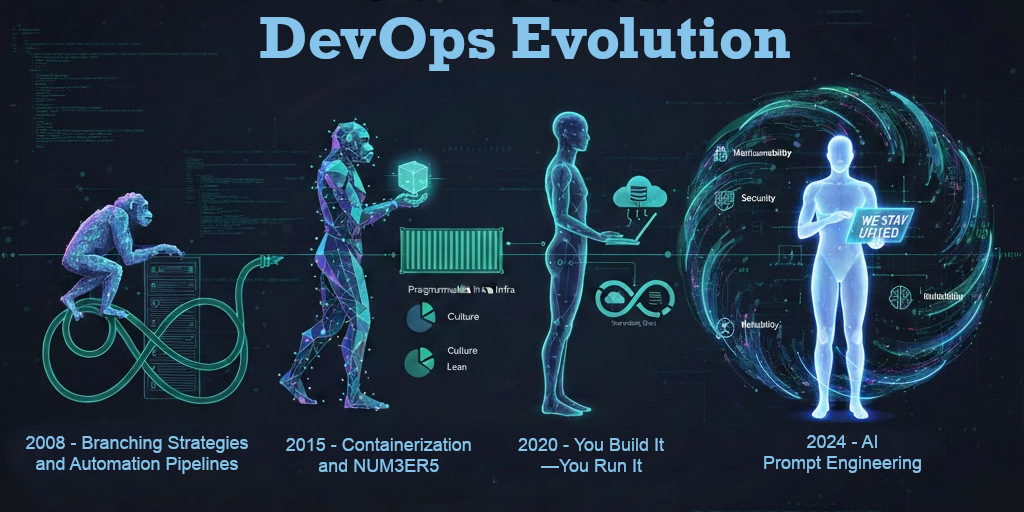
What is DevOps? We have discussed that question since the concept hatched around 2008, but maybe the better move is not to over define it. Instead, reflect on what it embraces and keep the community open to change.
I wrote this essay to help potential speakers decide whether a topic fits a DevOps conference. It still serves that purpose, but it also works as a guide for participants who want a feel for the range of ideas that sit under the DevOps umbrella.
The DevOps timeline
DevOps began as the Twitter hashtag #DevOps around 2009 in Ghent, tied to a conference on agile infrastructure. The next year the recurring event took the DevOpsDays name, and the movement kept evolving from there.
The early years often treated DevOps as a synonym for CI/CD. Jenkins, continuous integration, and continuous delivery became the dominant references, and for a while the story was mostly about faster automation and better release flow.
2008 to 2015: branching strategies and automation pipelines
Books by Paul Duvall, Jez Humble, and David Farley helped define the first shared vocabulary. There was no formal DevOps manifesto, but the ideas lined up closely with Agile thinking: automate early, reduce friction, and keep the main branch shippable.
Jenkins became the default build system for many teams. It was the era where build automation itself felt like a breakthrough, and it gave DevOps a practical center of gravity.
2015 to 2020: containers, infrastructure as code, and observability
Docker and Kubernetes changed the conversation. Configuration as Code and Infrastructure as Code turned infrastructure into something programmable, reproducible, and reviewable.
At the same time, observability matured. Prometheus, the ELK stack, and later SRE practices gave teams new ways to understand complex systems. Security also moved closer to the delivery flow through DevSecOps, while FinOps started to push back against runaway cloud spending.
This was also the period where the old story of DevOps as culture became harder to ignore. Breaking down silos mattered just as much as the tools.
2020 to 2023: serverless, full-stack, and DevX
Serverless platforms and managed backends lowered the barrier to shipping software. GitHub Code spaces, dev containers, and remote-first work shifted DevOps thinking from infrastructure teams toward every developer’s daily workflow.
That is where Developer Experience, or DevX, started to feel like a natural extension of DevOps. The development environment itself became part of the system that needed to be optimized.
2024 and beyond: AI enters the room
GitHub Copilot, prompt engineering, and AI-assisted development have changed the pace of software creation again. That creates obvious quality risks, but it also reinforces some core DevOps values: fast feedback, shared responsibility, and continuous learning.
The important question is not whether AI is good or bad in the abstract. It is how we keep maintainability, security, and reliability in view while the tools around us change quickly.
Contemporary DevOps buzzwords
DevOps keeps expanding, so the glossary keeps expanding with it. A few examples that now belong in the conversation:
- Automation / Autonomation
- Configuration as Code
- Containerization
- Continuous Delivery
- DevContainers
- DevSecOps
- DORA Metrics
- GitOps
- Infrastructure as Code
- Observability
- Platform Engineering
- Serverless / FaaS
- Site Reliability Engineering (SRE)
- Terraform
- You Build It, You Run It
DevOps is not dead. It is broader than the tools that first popularized it, and it keeps absorbing new practices as the software landscape changes.


